Heavyweight T-Shirts Explained: Why 6.1 oz Matters for Streetwear
What does 6.1 oz cotton actually mean? A straight answer on heavyweight T-shirts, fit, fabric weight and choosing graphic tees you will keep wearing.

In this story
A good graphic gets your attention.
The T-shirt underneath it decides whether you actually want to wear it again.
We have all seen the other version. An incredible print on a shirt that hangs strangely, feels paper-thin or loses its appeal the moment you put it on. The artwork did its job. The garment didn't.
That is one reason heavyweight T-shirts matter in streetwear. Not because heavier automatically means better. It doesn't. But because fabric weight changes the way a shirt sits, moves and feels — and those things affect the entire outfit.
So what does 6.1 oz cotton actually mean? Is heavyweight the same as oversized? And how do you know whether a graphic tee is worth adding to your rotation?
Forget the hype for a minute. Let's talk about the shirt.
What Is a Heavyweight T-Shirt?
Fabric weight measures how much material weighs over a fixed area. For T-shirts, it is usually expressed as GSM (grams per square meter) or oz/yd² (ounces per square yard).
It is not the weight of the entire finished shirt. A size 3XL will normally use more fabric than a size S, even if both are made from the same material.
There is no universal rule that every brand follows, but these ranges are useful starting points:
- Lightweight — roughly under 160 GSM: generally thinner, with a softer, more fluid drape.
- Midweight — roughly 160–200 GSM: a versatile middle ground for everyday T-shirts.
- Heavyweight — roughly 200 GSM and above: typically more substantial, often with a more structured feel.
Those are guides, not official labels. A brand might call 190 GSM heavyweight while another reserves that name for 240 GSM or more. The number is more useful than the marketing adjective.
What Does 6.1 oz Mean on a T-Shirt?
When a T-shirt is listed as 6.1 oz fabric, that generally means its material weighs 6.1 ounces per square yard — approximately 207 GSM.
That puts it just over the commonly used heavyweight threshold.
There is a reason we like this range for graphic streetwear. It feels more substantial than many lightweight tees without automatically pushing into the super-thick, rigid end of the spectrum.
It can work on its own. It can also work under an open jacket or overshirt. And it gives the garment enough presence that the graphic is not the only thing defining the silhouette.
Does every 6.1 oz shirt feel identical? Absolutely not.
The cotton, knit, dye process, finishing and cut all change the result. Two T-shirts can share the exact same GSM and still feel like completely different products.
Weight tells you something important. It never tells you everything.
Does Heavyweight Mean Better Quality?
No. And this is where a lot of product descriptions get lazy.
A heavy T-shirt can still have poor stitching, an uncomfortable collar or a badly made print. A well-made lightweight tee can easily outperform a badly made heavyweight one in comfort and construction.
Before you buy, look beyond the number:
- Fiber and feel: is the fabric cotton, a blend, ring-spun, garment-dyed or treated in another way?
- Construction: what do the seams, collar and stitching tell you?
- Fit: does the cut match the way you actually dress?
- Print: is the artwork clearly shown, and are there close-up photos?
- Care: are there usable instructions for keeping the shirt and graphic in good shape?
Heavyweight should be a useful specification, not a substitute for answering basic questions.
If a listing has nothing to say beyond “premium heavyweight,” keep looking.
Why Heavyweight Graphic Tees Work in Streetwear
Streetwear is not just the design on the chest. It is proportion, texture, shape and how those elements work together.
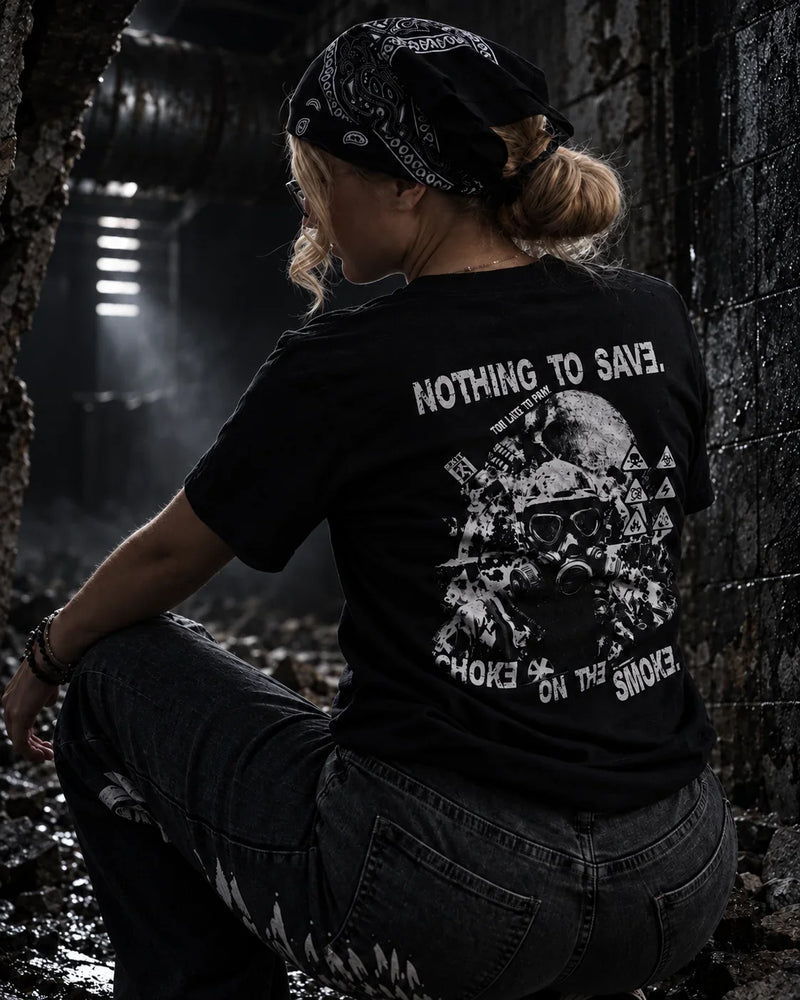
That is especially true in dark streetwear, where a black T-shirt might be paired with faded denim, wide trousers, a washed hoodie or a simple jacket. Sometimes the smallest difference in fabric changes how the entire outfit reads.
1. The silhouette has more presence
A more substantial fabric can hang with a little more structure rather than tracing every movement of the body. On a relaxed cut, that can create a cleaner outline from the shoulders down.
Notice the word can. Fabric weight affects drape, but pattern and fit matter just as much.
A heavyweight regular-fit tee does not magically become oversized. A lightweight shirt can still be cut boxy.
2. The artwork has a real foundation
We spend a lot of time thinking about graphics that feel like recovered warnings, corrupted symbols and fragments of worlds that should no longer exist.
But they still have to live on an actual piece of clothing.
With a substantial tee, there is a satisfying contrast between familiar everyday cotton and artwork that looks like it came from the other side of a collapsed civilization.
That does not mean heavier fabric automatically creates a better print. Print execution is its own craft. It means the garment and the graphic should be considered together.
For more on the artwork side, read how post-apocalyptic graphic tees become wearable artifacts.
3. It works without a costume
You don't need armor. You don't need a tactical vest or twelve unnecessary straps.
A substantial dark graphic tee, straight black trousers and shoes you already own can do more than an outfit built around trying too hard.
That is the difference between dressing like a character and wearing something that feels like it survived another world.
We get into the styling side in our guide to post-apocalyptic streetwear without looking like a costume.
Heavyweight vs. Lightweight T-Shirts: Which One Is Better?
Neither. Not until you know what you need it for.
Choose a heavier tee if...
- You like a more substantial feel against the body.
- You prefer relaxed silhouettes with a bit more structure.
- You often make your graphic tee the main piece of an outfit.
- You want a shirt that can stand on its own or sit under one open layer.
Choose a lighter tee if...
- You want a softer, more fluid drape.
- You spend a lot of time in hot weather and prefer less fabric weight.
- You frequently layer several garments and want less bulk.
- You simply like the feel of lighter clothing.
Comfort is personal. Climate matters. The same shirt can feel perfect on a cool evening and too much in direct summer heat.
Buy the weight that suits your life, not the word that sounds more expensive.
Fit Comes First: Relaxed, Oversized and Boxy Are Not the Same
People often see a loose T-shirt on a model and assume they should just order two sizes up.
Sometimes that works. Sometimes all you get is a very long shirt.
Relaxed fit usually means a roomier cut than a close-fitting tee. Oversized fit intentionally exaggerates some proportions. Boxy fit often emphasizes width relative to length.
These terms vary by manufacturer. More importantly, none of them describes fabric weight.
If you are buying online, compare the garment measurements to a T-shirt you already own and like. Check chest width, body length and shoulder measurements where available. Consider how the sleeve sits and whether you will wear the shirt alone or under a layer.
Choosing your usual size for a designed relaxed fit may already give you the look you want. Size up only if the measurements support the silhouette you are after.
Good streetwear isn't about wearing the biggest thing possible.
It is about making the proportions work.
Why OLD VEGAS Uses 6.1 oz Cotton on Our Graphic Tees
At OLD VEGAS, the art usually makes the first impression.
Eyes that look back. Signals that never stopped transmitting. Roses growing through the damage. Messages from somewhere you probably should not have gone.
But a graphic cannot carry a bad garment forever.
That is why several pieces in our graphic tee archive use 6.1 oz heavyweight cotton, relaxed unisex fits and pre-shrunk construction.
Consider the All Seeing Hand Graphic Tee. The surreal eye-and-hand graphic is the part you notice first. Underneath it is 100% ring-spun US cotton, garment-dyed for a worn-in finish, in a relaxed unisex cut. The product page lists 6.1 oz fabric, tubular construction and double-needle stitching.
Or take the Apocalyptic Rose Graphic Tee. A dark rose and toxic-green details do the talking. The garment uses the same listed 6.1 oz heavyweight cotton and relaxed fit.
Two different worlds. A familiar everyday foundation.
These details help you decide if the shirt is right for you; they are not a promise that cotton is indestructible or that every body will like the same fit.
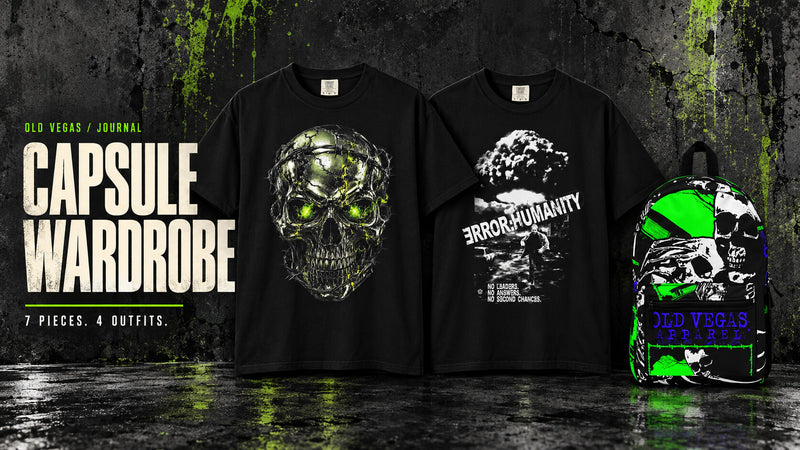
For a closer look at the stories behind several designs, explore Choose Your Aftermath. If you want fewer pieces doing more work, our seven-piece streetwear capsule wardrobe shows how to build around one strong graphic.
How to Keep a Heavyweight Graphic Tee in Rotation
A thick shirt is still a shirt. Cotton can shrink, color can fade and graphics can wear if you treat them badly.
Pre-shrunk does not mean shrink-proof. And a garment-dyed finish may change with washing and wear — which can be part of its character, but still deserves care.
Start with the care label for the specific garment. For printed tees, a few simple habits are worth keeping:
- Follow the label's wash and temperature instructions.
- Turn the shirt inside out to reduce unnecessary friction on the print.
- Avoid excessive heat during washing and drying.
- Never iron directly over the artwork.
- Use the listed size and care details rather than assuming all heavyweight tees behave alike.
You do not need a complicated ritual. Just don't confuse substantial fabric with invincibility.
Heavyweight T-Shirt FAQ
Is 6.1 oz considered heavyweight?
Generally, yes. Fabric weighing 6.1 oz per square yard is approximately 207 GSM, which falls into a commonly used heavyweight range. Brands may classify weights differently.
What is the difference between GSM and oz?
They measure the same idea — fabric mass over a fixed area — using different units. GSM means grams per square meter; T-shirt ounces usually means ounces per square yard. A 6.1 oz/yd² fabric is about 207 GSM.
Are heavyweight graphic tees better for printing?
Not automatically. A substantial garment can offer a different feel and drape, but print results depend on the printing process, artwork, preparation and production quality as well as the fabric.
Are heavyweight tees always oversized?
No. Heavyweight refers to the material; oversized refers to the cut. Check garment measurements instead of assuming one means the other.
Do heavyweight cotton T-shirts shrink?
They can. Pre-shrinking reduces the likelihood of major dimensional change, but does not guarantee zero shrinkage. Follow the garment's care instructions.
Are heavyweight T-shirts good in hot weather?
That depends on the climate, fit, fabric and how you handle heat. Lightweight tees may feel more comfortable during high temperatures, while some people prefer the feel of heavier cotton year-round.
The Graphic Gets Noticed. The Shirt Gets Worn.
A graphic can take you somewhere strange.
An abandoned city. A warning from a dead system. A memory of a future that never existed.
But when you leave the house, it still has to be a T-shirt.
Check the weight. Check the construction. Compare the measurements. Choose artwork that you actually want to live with.
We will keep building the world around it.
Explore OLD VEGAS heavyweight graphic tees →
WEAR THE AFTERMATH.
Continue Through the OLD VEGAS Journal
Wear the aftermath.
Original art. Dark streetwear. Find your next piece in the OLD VEGAS archive.