What Cinema Taught Dark Fashion About the End of the World
Before a ruined future becomes a T-shirt, it becomes a frame. How Blade Runner, Mad Max: Fury Road, and The Matrix taught dark fashion atmosphere instead of cosplay.

In this story
Before a ruined future becomes a T-shirt, it usually becomes a frame.
Someone lights a corridor the wrong color. Someone wraps a body in leather that used to be something else. Someone decides the hero should look wet, underfed, over-armed, or almost ordinary. Then the image leaves the theater and starts living in closets.
Dark fashion did not invent dystopia. Cinema taught a mass audience how dystopia should look when it walks.
OLD VEGAS grew out of games, ruined systems, and broken broadcasts—that story already lives in the Journal. This piece looks at the other inheritance: costume design. Not cosplay. Not a shopping list of movie replicas. The quieter transfer of atmosphere from screen to street.
Cinema as a rehearsal for collapse
Science-fiction clothing tends to split into two moods. One is clean and hopeful: laboratory silhouettes, bright polymers, unbroken surfaces. The other is dystopian: dark, militaristic, tattered, recycled, or quietly wrong.
Costume scholar Deborah Nadoolman Landis has drawn that split plainly—hopeful science fiction often reads refined, while dystopian stories cue menace or rugged damage. She has also pointed out an awkward truth designers already know: even when a director begs for something never seen before, fashion remains a recycling system. Ideas return wearing new dirt.
That is useful for streetwear. The clothes people actually buy cannot be pure invention. They have to be understood in public. Cinema does the translation work first. It shows an audience which textures mean danger, which silhouettes mean surveillance, which colors mean the power is failing.
Blade Runner: rain, shoulders, and the near future that already happened
Ridley Scott's Blade Runner (1982) remains one of the most cited fashion references in dystopian style, with costume design by Charles Knode and Michael Kaplan. Designers across decades—Raf Simons, Gareth Pugh, Alexander McQueen, Matty Bovan among those named in fashion coverage—have drawn from its weather, its noir, and its refusal to make the future look new.
Landis has described Sean Young's Rachael as a 1940s fantasy in the wrong century: big shoulders, structured suits, Adrian-adjacent glamour dropped into acid rain. The lesson is not "wear a trench coat." The lesson is temporal collision. The future feels convincing when it is haunted by older clothes.
Street-level dark fashion borrowed that collision. A graphic tee under a long coat. A polished portrait dragged through noise. A silhouette that looks expensive and exhausted at the same time. You can feel that inheritance in pieces like the Look Into My Eyes Graphic Tee, where a familiar face survives damage instead of arriving pristine. The shirt is not a Blade Runner replica. It understands the same rule: beauty after interference.
Mad Max: Fury Road: junk as narrative
If Blade Runner taught fashion how a city dies stylishly, Mad Max: Fury Road (2015) taught it how scarcity dresses a body.
Costume designer Jenny Beavan—coming from period drama rather than wasteland spectacle—won the Academy Award for Best Costume Design in 2016 for the film. Reporting around the production describes a method built from trash and necessity: car parts, cutlery, scavenged junk, leather, masks, goggles, harnesses hidden inside character logic. Beauty was not applied on top of survival. Survival became the look.
Beavan has talked about Namibia's recycling ethos informing the work, about sand forcing eye protection into nearly every costume, about safety hardware that had to disappear into the design. That is why Fury Road still matters to dark streetwear more than most desert epics. It made function visible without turning every outfit into a novelty vest.
The wearable translation is restraint plus residue. One warning graphic. One damaged texture. One layer that feels like protection rather than theater. An emergency broadcast on a black tee—such as the corrupted signal energy in the Zombie Red Alert Graphic Tee—works for the same reason Beavan's junk wardrobe worked: it implies a system that already failed, then lets the rest of the clothes stay ordinary.
The Matrix: black as operating system
The Wachowskis' The Matrix (1999), with costume design by Kym Barrett, gave dark fashion a different gift: clarity.
Black leather, long coats, sunglasses, severe lines. The look became so famous it risked becoming costume. But underneath the meme was a useful idea for alternative streetwear: monochrome as interface. When the world is over-stimulating, black reduces the signal. Shape and graphic become the only text.
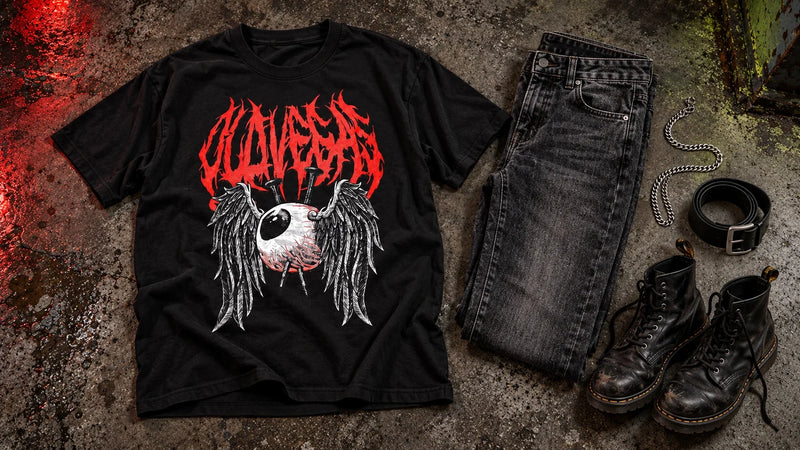
That is why a single symbol on a heavy black tee can feel more current than a full thematic uniform. The Dead Eyes Graphic Tee—a winged eyeball framed in jagged red lettering—operates like a system icon. You do not need the rest of Neo's closet. You need the stare.
What transfers to clothes people actually wear
Movie costumes are engineered for cameras, stunts, and myth. Closets are engineered for grocery stores, trains, and bad lighting. The transfer only works when you steal principles instead of props.
- Atmosphere over armor. Cinema sells a weather system: rain, dust, neon failure, static. Clothes should carry that weather in color, texture, and graphic mood—not in foam weapons.
- One recovered object. In Fury Road, junk becomes biography. In streetwear, one print can do that job if the rest of the outfit stays quiet.
- Old forms in damaged futures. Blade Runner's power is anachronism. A classic portrait, a tattoo skull, a formal collar under ruin—these collisions feel smarter than pure futurism.
- Black as infrastructure. The Matrix proved monochrome can be modern rather than gothic-only. Use it as the operating system, then let one graphic speak.
Those principles sit beside, rather than on top of, the games that shaped OLD VEGAS. Interactive worlds teach systems and survival loops. Films teach silhouette and light. Together they explain why broken futures keep looking good on ordinary streets—a theme we have already chased in dystopian streetwear and in the visual habit of loving damage itself in Why Everything Looks Better After It’s Been Destroyed.
The costume mistake dark fashion still makes
The failure mode is obvious: treating a reference as a checklist.
Goggles plus harness plus distressed everything plus three warning patches equals a character, not a person. Landis's observation about costume needing to be understood by a contemporary audience cuts both ways. If the outfit only makes sense inside a franchise, it is not streetwear. It is a weekend uniform.
Cinema's real gift to dark fashion was permission to look unfinished. Not unfinished as careless—unfinished as aftermath. A shirt that looks recovered. A hoodie that looks like shelter. A graphic that feels intercepted rather than marketed.
That is the OLD VEGAS reading of the screen: not dress like Furiosa, Deckard, or Trinity. Dress like someone who watched those futures end, then went outside anyway.
Keep the frame, lose the set
The best dystopian films do not ask you to live on the set. They ask you to recognize the weather.
If a piece of clothing carries that weather—corrupted signal, damaged beauty, a symbol that stares back—it has already done the cinematic work. Browse the graphic tees when you want the frame in cotton form. Or stay with the Journal and keep reading the world that clothes are trying to survive.
The end of the world, on film, was always a costume problem first. Streetwear inherited the solution: look like the lights already flickered, and keep moving.
Wear the aftermath.
Original art. Dark streetwear. Find your next piece in the OLD VEGAS archive.